
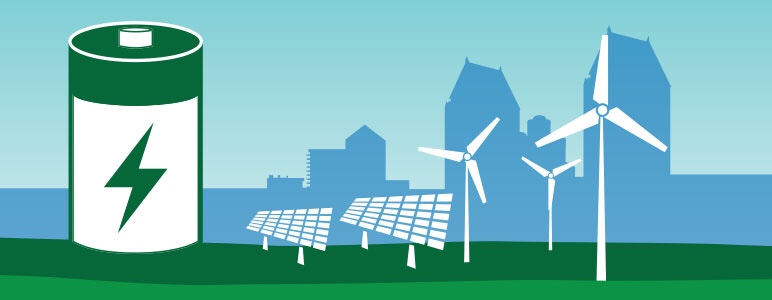
There are promising green energy alternatives on the horizon. Solar, wind, and even wave (ocean) technology is in the works and producing promising results. However the problem with powering entire electrical grids with these energy forms is storage.
Unfortunately these sources are not consistently abundant – sometimes its cloudy or nighttime, sometimes the wind dies down – we need the ability to store energy produced during peak hours so that it can cover for the times when it cant be produced.
One such endeavor I detailed in a prior post, it talked about NantEnergy CEO, Dr. Shiung-soon, who is working to produce a Zinc-oxide battery, which has already reached the coveted $300/kilowatt-hour threshold. For comparison, the lithium-ion batteries, which have been made popular by Elon Musk and Tesla, are closer to $1000/kilowatt-hour.
You might be asking yourself, well why then are we not devoting significant resources towards making these batteries a functioning reality? The Zinc-oxide battery being produced by NantEnergy is still in it’s infancy – they just announced it. For now, lithium-ion batteries remain our most promising technology and with Solar energy not being widespread enough, it’s difficult to justify the $1000/kilowatt-hour price of production when just the typical fridge uses around 5 kilowatt-hours a day.
Apart from other companies address this need for storage, coming up with new forms of technology, there are also investments being made by the electric vehicle industry that are constantly bringing down the cost of lithium-ion batteries.
So while this need for storage doesn’t occupy headlines on a daily basis, it’s clearly a problem that companies are addressing. And it’s not just new and improved batteries, there are also improvements to our countries electrical grid that would help solve the problem.
We have noticed in recent years a strong push towards the development of smart grids, which are more adaptive and better equipped to handle the levels of energy required by this modernizing world. And a huge component of the electrical grid improvements, is improving storage capacity.
I believe this is our next big problem to tackle if we are going to ever successfully implement these alternative forms of energy in a way that will produce continuous, and stable electricity across the grid.
 EcoTech